Smoke-resistant doors in hospitals: what do Sa, S200 and Sa3/Sa4 mean?
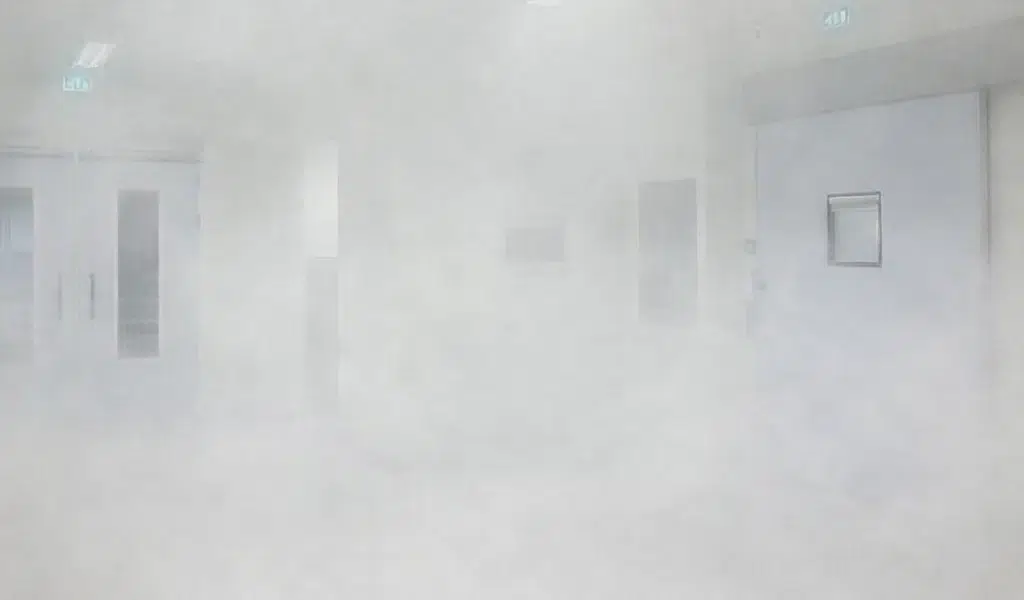
When a fire occurs in a hospital, smoke is often more dangerous than the flames themselves. It reduces visibility, impairs breathing and can make evacuation difficult within minutes. In healthcare environments, where patients may not be able to evacuate independently, smoke control is therefore critical.
In practice, however, smoke resistance is still sometimes treated too simplistically, as if fire resistance and smoke resistance automatically go hand in hand. That is exactly where problems begin. A construction can be fire-resistant while smoke still leaks through joints, perimeter gaps or threshold details. For that reason, smoke performance is assessed separately in Europe. Smoke leakage of door assemblies is tested according to EN 1634-3, while the resulting performance is classified under EN 13501-2.
Smoke resistance is not new. The way it is assessed has changed.
Smoke control has been part of fire safety for a long time. What has changed is the way performance is measured and classified. Instead of assuming smoke protection from fire resistance, current European practice is based on dedicated smoke leakage testing under defined pressure and temperature conditions.
Most specifiers are familiar with two common indicators:
Sa for smoke control at ambient temperature
S200 for smoke control at elevated temperature up to 200 °C
More recent classification practice may also refer to Sa3 or Sa4. These designations relate to the test and classification configuration of the doorset and are becoming more visible in updated European classification practice. For architects and specifiers, that is a useful reminder that reading the classification report matters more than relying on a label alone.
What does this mean for hospital design?
In hospital projects, the correct smoke classification is not a minor technical detail. Spaces where occupants may be sleeping or depend on assistance generally require a higher level of smoke containment than areas with more straightforward evacuation conditions. This makes the link between occupancy, compartmentation and door performance essential.
At the same time, classification alone is not enough. A smoke-resistant door never operates in isolation. Sealing, installation quality, pressure differences between spaces, automatic closing in response to fire detection and the position of the door within the compartment strategy all influence real-life performance. Metaflex classification reports, for example, explicitly combine fire resistance, smoke control and self-closing performance.
Where does specification become critical?
For architects and healthcare specifiers, the challenge is rarely the terminology itself. The real question is how to translate performance classes into the right application. Which level of smoke control is appropriate for patient rooms, ICUs, circulation routes or protected escape areas? And how should that requirement be balanced with hygiene, logistics and day-to-day usability?
That is where smoke resistance becomes a design decision rather than a compliance checkbox.
Smoke control starts at the design stage
If smoke control is considered too late in the process, projects risk discussion during execution or doors that are technically compliant but not optimally integrated into the building concept. By addressing compartmentation, classification, airtightness and self-closing behaviour early in design, teams can create a more robust fire safety strategy.
For a more detailed explanation of the relevant classifications, their practical implications and the role of doors in healthcare design, the whitepaper provides a broader technical overview.
Hygiene in hospitals does not start with cleaning. It starts with control. Control of airflow. Control of pressure differentials. Control of what moves invisibly between spaces. In healthcare environments, an airtight door is not simply a construction detail. It is a functional component of a controlled environment. What is an airtight door? An airtight door […]
The ASSA ABLOY Portugal technical and sales teams recently visited Metaflex in Aalten, the Netherlands, for a two-day technical and commercial training. The goal was to prepare for future growth in the Business Segment Pedestrian healthcare sector by learning more about the Metaflex hermetic doors. “Our goal was to achieve maximum installation knowledge,” said Rui […]
Consumers must be able to 100% trust in the fact that the food they purchase is safe. After various food safety issues, such as the listeria bacteria, it has become top priority for many companies in their business operations. But why is food safety so important and how do you ensure that food safety is […]
We use technologies like cookies to store and/or access device information. We do this to improve browsing experience and to show personalized ads. Consenting to these technologies will allow us to process data such as browsing behavior or unique IDs on this site. Not consenting or withdrawing consent, may adversely affect certain features and functions.
Functional
Always active
The technical storage or access is strictly necessary for the legitimate purpose of enabling the use of a specific service explicitly requested by the subscriber or user, or for the sole purpose of carrying out the transmission of a communication over an electronic communications network.
Preferences
The technical storage or access is necessary for the legitimate purpose of storing preferences that are not requested by the subscriber or user.
Statistics
The technical storage or access that is used exclusively for statistical purposes.The technical storage or access that is used exclusively for anonymous statistical purposes. Without a subpoena, voluntary compliance on the part of your Internet Service Provider, or additional records from a third party, information stored or retrieved for this purpose alone cannot usually be used to identify you.
Marketing
The technical storage or access is required to create user profiles to send advertising, or to track the user on a website or across several websites for similar marketing purposes.