Fire-resistant doors are subject to increasingly stricter requirements. The fire-resistant Metaflex door systems have been successfully tested according to the latest standards. So, what happens during such a test?
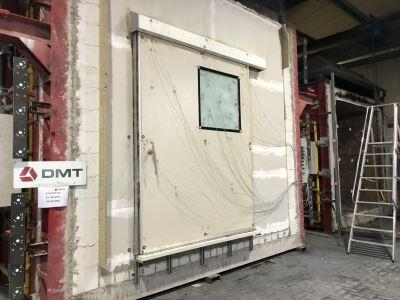
First, we determine which facets we will take into account, such as height x width dimension, window size and position of the window. In addition, the wall used to test the door is also a decisive factor.
Standards and requirements
When testing, we want to meet the following standards and requirements:
- Fire resistant according to EN 1363-1:2012-10 and EN 1634-1:2014-03, classifications E, EI1, EI2, EW (30 and 60 minutes);
- Hot (S200) and cold (Sa) smoke resistant according to EN 1634-3:2004 and EN 13501-2, class C5 according to EN 1191:2012;
- Relevant durability test according to EN 1191:2012 of 200,000 cycles, performed three times to also comply with the German DIBt;
- Air permeability according to EN 1026.
Door leaf assessment criteria
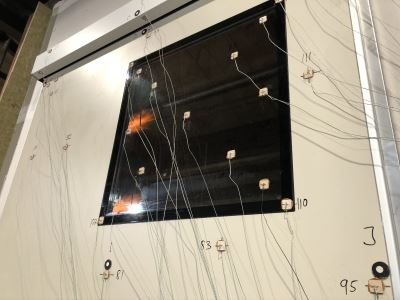
Door leaves are assessed based on various criteria. Integrity (E) ensures that a door system does not allow any flames or hot gases to pass through. Insulation (I) involves testing the door system for insulation. A distinction is made here between I1 (the most critical procedure) and I2. In both cases, the average temperature of the door leaf may not exceed 140°C compared to the initial temperature. This is measured using standard thermocouples that are glued to the door leaf. The big difference between I1 andI2 is that extra thermocouples are placed around the door leaf (the most critical position), for I1 at 25 mm and I2 at 100 mm distance from the door frame. It should be noted that the temperature of these thermocouples may not exceed 180°C compared to the initial temperature.
Material properties
A material may catch fire or melt down during a fire test. Furthermore, the mechanical properties of materials can change as the temperature increases. Heat can cause materials to expand, which in turn can cause a door or door frame to bend. There are also materials that insulate, cool or foam, which prevents flames from spreading. Through clever use of materials and their specific properties, a door system can pass a fire test.
1, 2, 3… test!
After the door has been installed in the wall and all thermocouples have been attached to the door leaf and frame, the system is ready to be tested. For this test, a standardised fire curve is used. After 5 minutes, the temperature in the oven will rise to 576°C and after 15 minutes even to 738°C. During the crucial first 15 to 20 minutes, all materials start to work and most of the smoke will pass through the door leaf and frame. After this phase, the intumescent strips begin to create a seal between the door and frame.
To the boiling point and further
After 45 minutes the oven temperature has risen to 90°C. With a 60-minute fire-resistant door, the last 10 to 15 minutes are critical a well. Materials with fire-resistant or cooling properties contain crystallised water and/or moisture. As long as this remains in the door leaf, the door leaf will not become much hotter than 100°C (boiling point). After a certain time, the moisture from the door leaf will evaporate, causing the temperature to rise quickly. In addition, warping of materials can cause large gaps through which flames can spread.
Immense heat
After 60 minutes, the fire test is often continued for several minutes to see whether a certain excess value can be achieved. In the case of medical doors, it is still possible to touch the door leaf after 60 minutes. That makes it hard to imagine that the temperature in the oven has now risen to 945°C. When the extra minutes have passed, the oven is turned off and the complete wall system is removed from the oven. Only then does it become clear how immensely hot 945°C is. And most importantly: whether the test was successful!
Want to find out more? Please contact one of our advisers. We will be happy to help you.